Gotham City is the hometown of Batman and the Bat-Family. Though it first appeared in Detective Comics #27, it was first identified by Bill Finger in Batman #4 (Winter 1940). Often depicted to be on the East Seaboard of the United States, Gotham has changed depiction, including with the city geography and architecture. From the Bronze Age of Comics, Gotham's politics has often been depicted as having heavy ties to organized crime and corruption. Gotham itself has become a major location in the DC Universe, with many characters like Superman, Swamp Thing, Green Lanterns and the JLA visiting the city on occasions.
History
In Swamp Thing #52, Alan Moore established that Gotham City was founded in 1635 by Captain Jon Logerquist.[1] Other writers have generally followed this backstory for Gotham City. According to the regular version of this story, Jon Logerquist was a Swedish mercenary who served the Swedish Empire during the Thirty Years' War and fought in the Battle of Nördlingen in Swabia. In order to flee the religious wars that were raging throughout Europe, Logerquist and a small group of colonists decided to pursue a new life in North America, where they established a settlement on the East Coast in 1635. Captain Logerquist named the territory Fort Adolphus after Swedish king Gustavus Adolphus, who had died in the Battle of Lützen a few years earlier.[2][3]
Fort Adolphus along with New Netherland was later ceded to the British in 1674 and English General Adam Howe took over as governor. Howe then renamed the settlement Gotham City.[3] To an extent, this mirrors the history of many American cities that changed hands over the course of time. During the American Revolutionary War, Gotham City was the site of a major battle and rumors held it to be the site of various occult rites.
Shadowpact #5 by Bill Willingham expands upon Gotham's occult heritage by depicting a being who has slept for 40,000 years beneath the land upon which Gotham City was built. Strega, the being's servant, says that the "dark and often cursed character" of the city was influenced by the being who now uses the name "Doctor Gotham."
Many storylines have added more events to Gotham's history, and at the same time affecting the city and its people greatly. Perhaps the greatest in impact was a long set of serial storylines, which started with Ra's Al Ghul releasing a debilitating virus called the "Clench" during the "Contagion" storyline. As that arc wrapped the city was beginning to recover only to suffer an earthquake described as being 7.6 on the Richter Scale in "Cataclysm". This resulted in the federal government cutting Gotham off from the rest of the United States in "No Man's Land." This trio of storylines allowed writers the freedom to redefine the nature and mood of the city. The result suggested a harder city with a more resilient, resourceful, and cynical populace; a more dramatic and varied architecture; and more writing possibilities by attributing new locales to the rebuilding of the city.
Name and New York City connection
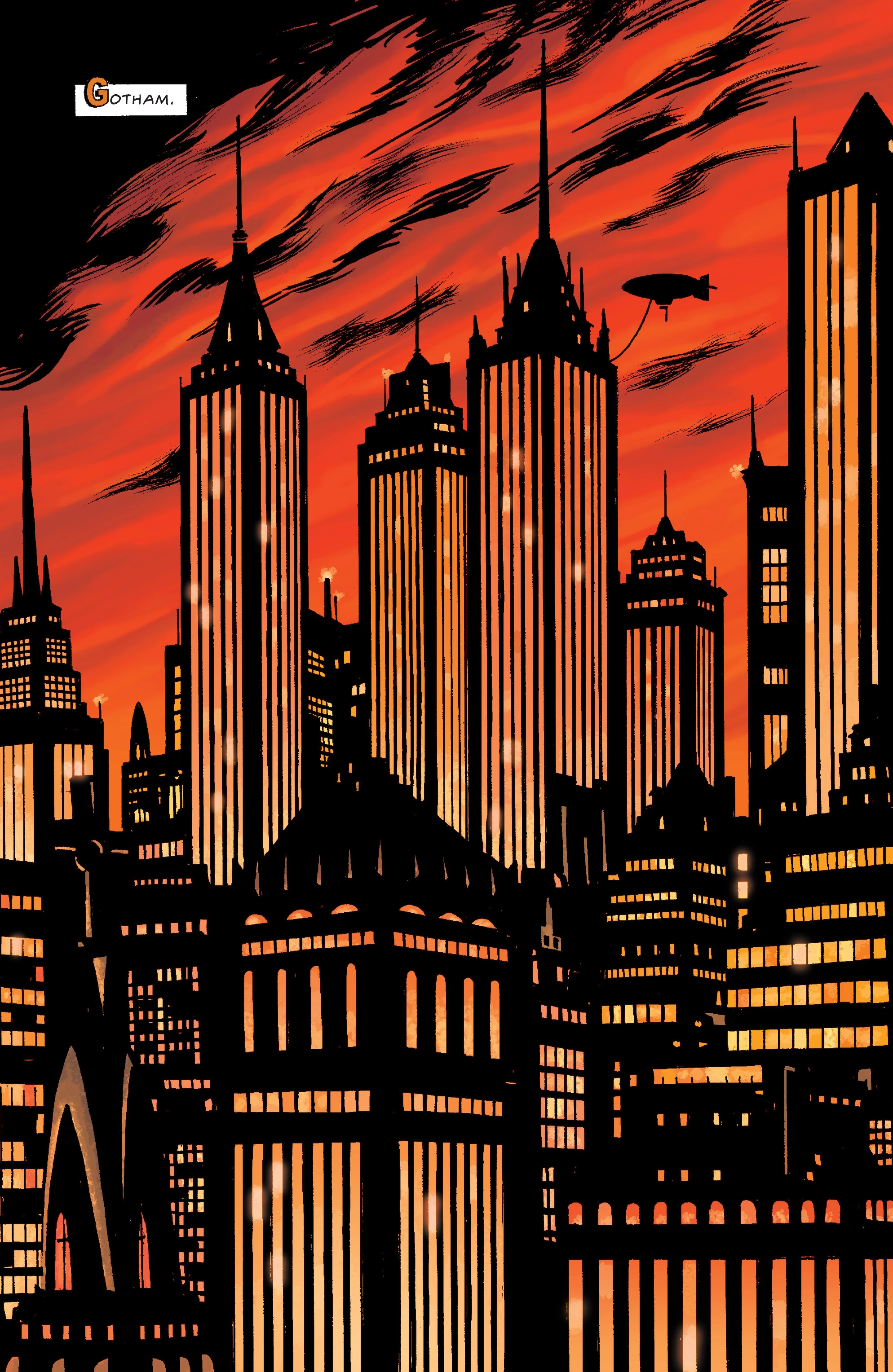
Before Detective Comics #48, Batman's adventures were said to happen in New York City. Gotham is known to be architecturally modeled after New York City, but with exaggerated elements of the styles and derives its name from a sobriquet for that real world city, first popularized by the author Washington Irving in his satirical work Salmagundi (1807).
Prior to that the term "Gotham" had been used to refer to places with foolish inhabitants since as early as the mid-15th century. The existence of Gotham, Nottinghamshire in the DC Universe was acknowledged in Batman: Legends of the Dark Knight #206 (and again in 52 #27), although the connection between two names within the DCU has not been fully explained. In a story titled 'Cityscape' in Batman Chronicles #6 it is revealed that Gotham was initially built for the purpose of housing the criminally insane, and Robin reads a journal that tells of how Gotham got its name; "I even have a name for it. We could call it 'Gotham' after a village in England - where, according to common belief, all are bereft of their wits.
The name "Gotham City" is generally associated with Batman and DC Comics, although it also appears in the first Mr. Scarlet story by France Herron and Jack Kirby from Wow Comics #1. Kirby historian Greg Theakston notes that this was published December 13, 1940, shortly before Detective Comics #48 was published.
Atmosphere
In terms of atmosphere, Batman writer and editor Dennis O'Neil has said that, figuratively, "Batman's Gotham City is Manhattan below Fourteenth Street at eleven minutes past midnight on the coldest night in November."[4]
Gotham City's atmosphere took on a lighter tone in the comics of the 1950s and part of the 1960s, similar to the tone of Batman stories of that era. However, by the early 1970s the tone of the city, as well as that of the stories, had become grittier. In recent decades, the portrayal of Gotham has been as a dark and foreboding place rife with crime, grime, and corruption.
Architecture
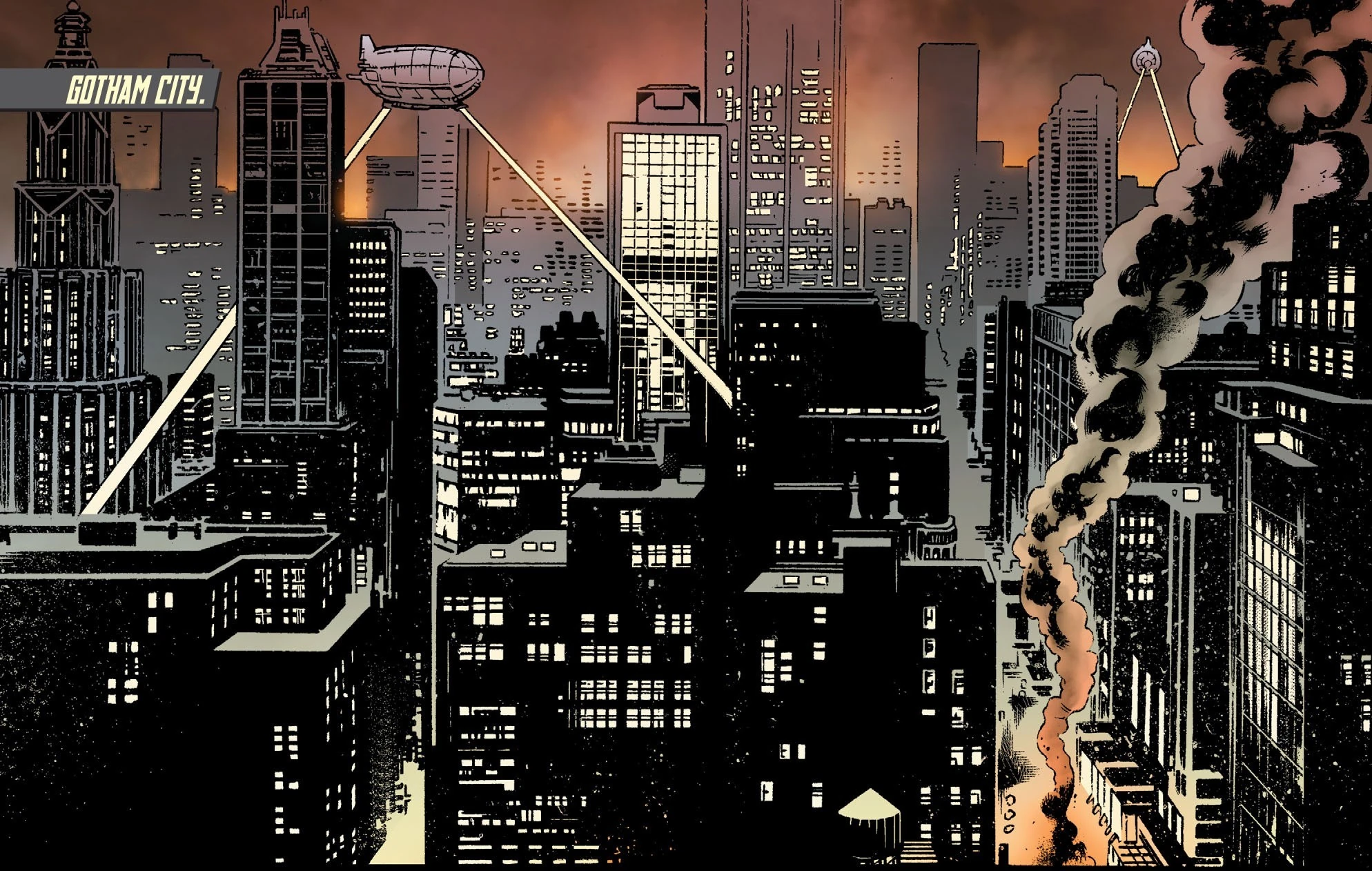

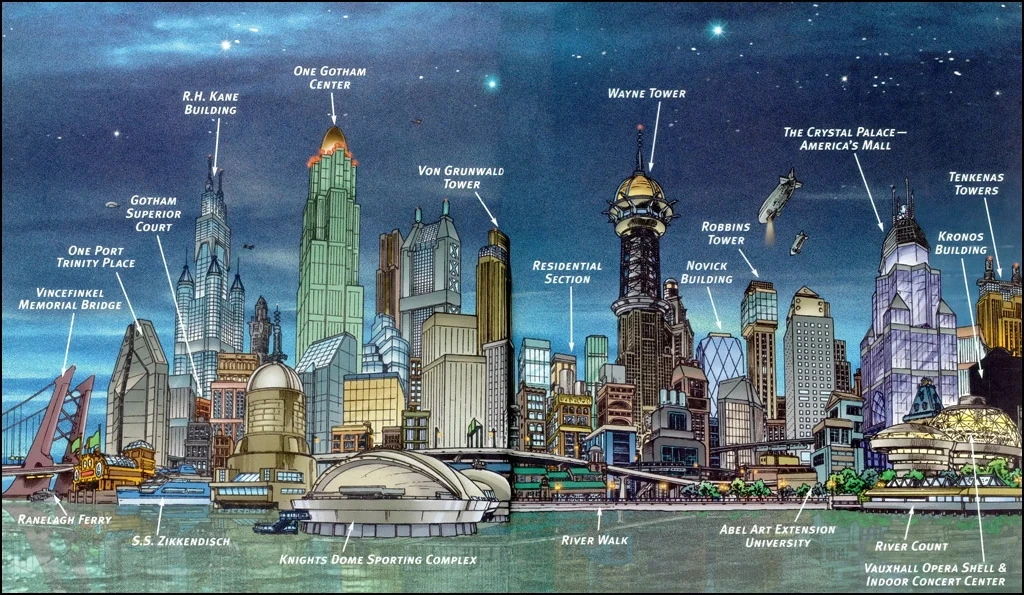
Gotham skyline by night.
Different artists have depicted Gotham in different ways. But they often base their interpretations on various real architectural periods and styles, with exaggerated characteristics, such as massively multi-tiered flying buttresses on cathedrals, or the huge Art Deco and Art Nouveau statuary seen in Tim Burton's movie version. Within the Batman mythos, the person cited as being influential in promoting the unique architecture of Gotham City during the pre-American Civil War era was Judge Solomon Wayne, Bruce Wayne's ancestor. His campaign to reform Gotham came to a head when he met a young architect named Cyrus Pinkney. Wayne commissioned Pinkney to design and to build the first "Gotham Style" structures in what became as the center of the city's financial district. The "Gotham Style" idea of the writers matches parts of the Gothic Revival in style and timing. In a 1992 storyline, a man obsessed with Pinkney's architecture blew up several Gotham buildings in order to reveal the Pinkney structures they had hidden; the editorial purpose behind this was to transform the city depicted in the comics to resemble the designs created by Nigel Phelps for the 1989 Batman film.
After "No Man's Land", Lex Luthor took the challenge of rebuilding Gotham City after the events of "Cataclysm". Gotham's old Art-deco and Gothic structures were replaced with modern glass skyscrapers and buildings.
GCPD and Corruption
A common theme in stories set in Gotham is the rampant and recurring corruption within the city's civil authorities and infrastructure, most notably within the Gotham City Police Department. During stories set early in Batman's career (most notably "Batman: Year One"), Commissioner Gillian B. Loeb was depicted as having his hands in many pockets. However, Batman found evidence for conspiracy charges, forcing Loeb to resign his position. Later stories depicted subsequent commissioners as also being corruptible, or open to various forms of influence. In other stories, Batman has had to take on crooked cops, either acting in collusion with supervillains, working for the mob, or on their own. Later stories, featuring James Gordon as the new Commissioner, show the two characters often uniting to purge corruption from the force. Gordon was the commissioner for about 9 to 10 years of continuity, then retired, handing the police force over to his replacement, Commissioner Akins.Template:Fact Recent stories have returned Gordon to the position of Commissioner.
Arkham Asylum
See: Arkham Asylum
Sports Teams
Gotham has a wide variety of sports teams; like their baseball teams, the Gotham Knights and the Gotham Griffins, their basketball team, the Gotham Guardsmen, their football team the Gotham Wildcats and their ice hockey team, the Gotham Blades. The Gotham Knights baseball team colors are black and gold like the Knights football team. The Griffins team colors are dark green and white. In The Dark Knight Rises directed by Christopher Nolan, several Pittsburgh Steelers players portray the fictional Gotham City football team, the Gotham Rogues. In The Batman, there is a different, or possibly an additional, basketball team called the Gotham Gators.
Geography
Gotham City's geography, like other fictional cities' geographies in the DC Universe, has varied over the decades, because of changing writers, editors and storylines. At various times the depiction has Gotham on the shores of "Lake Gotham". The majority of appearances, however, place Gotham on the eastern coast of the United States.
Maps shown in various comics have depicted the city in different places. Many of the maps directly use Manhattan, Vancouver, and other real coastlines as their basis, while others are completely original. One map showing Gotham City in relation to Metropolis, the home of Superman, published in New Adventures of Superboy #22 (October 1981), placed Gotham City and Metropolis on opposite sides of a large bay. In Swamp Thing vol. 2, #53 (October 1986) the geography of Rhode Island was the basis of another map of Gotham City. The current definitive maps of Gotham City are those based on the ones produced for the "No Man's Land" story arc.
The distance between Gotham City and Metropolis has varied over the years, ranging everywhere from being hundreds of miles apart to being twin cities on opposite sides of a large bay. Blüdhaven, a city that for several years was home to Nightwing, is located near Gotham City. Additionally, the Seven Soldiers of Victory series Klarion the Witch Boy, calls New York City the "Cinderella City", referring to nearby Metropolis and Gotham as its "ugly step-sisters".
One older theory was proposed by Mark Gruenwald, who later went on to be a major writer/editor at Marvel Comics, and published in the 1970s in the DC house fanzine, The Amazing World of DC Comics in an issue dedicated to the Justice League. Gruenwald suggested that Gotham City is located somewhere in the state of New Jersey while Metropolis is located in close vicinity to Washington, D.C.
Man-Bat #3 refers to Gotham City being in the Central Time Zone.
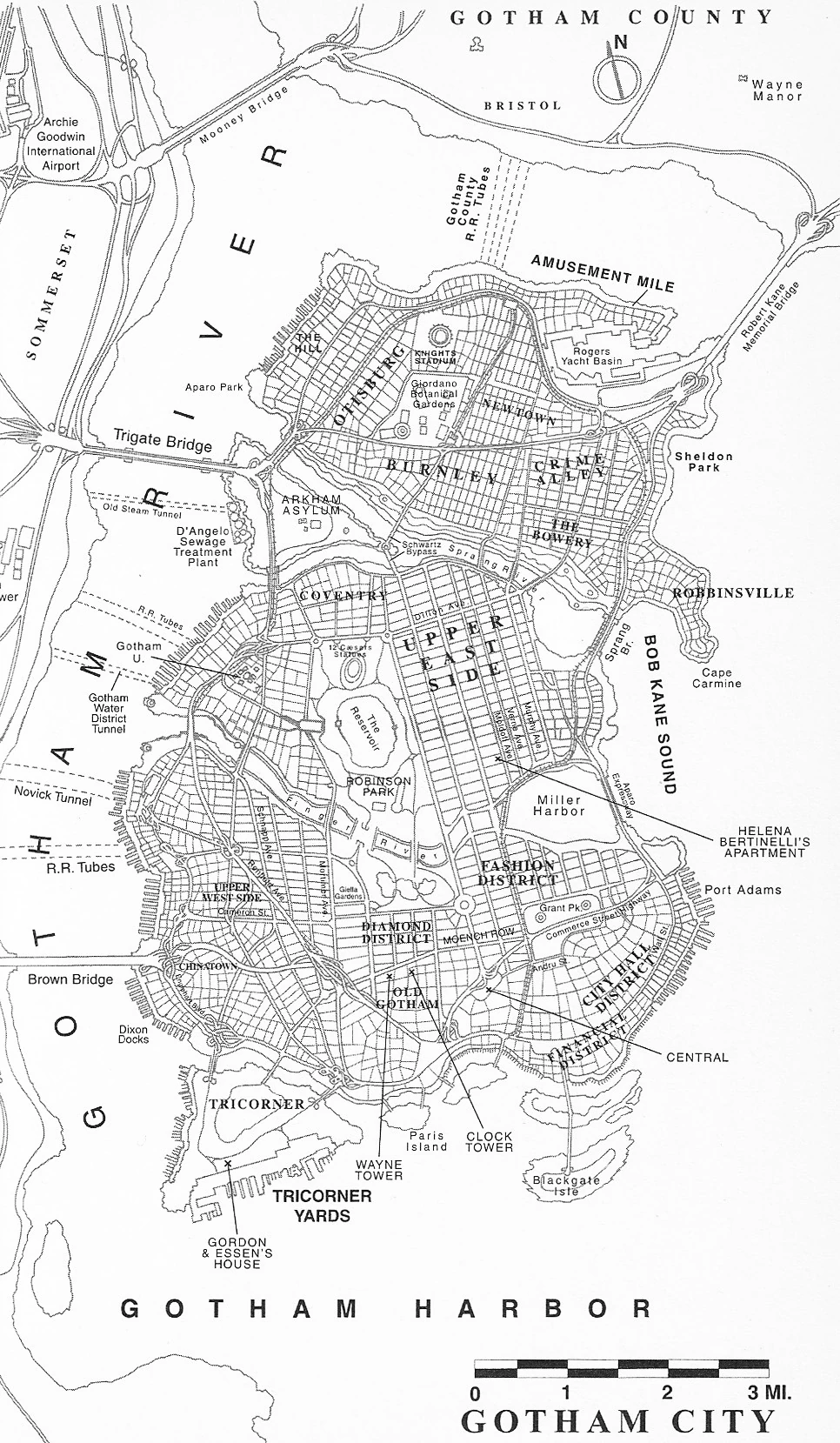

Fictional map of Gotham City in New Jersey
In Nightwing #153, when Dick Grayson moved back to Gotham City from New York City via commuter train, it was revealed that the travel time by train was six hours, while the same trip via air shuttle between the two cities was only 40 minutes.
According to the Planetary/Batman one-shot, a Gotham City also exists in the Wildstorm universe. It is similar to its DC Universecounterpart, but is not usually home to costumed vigilantes. In Captain Atom: Armageddon Gotham City does not exist in the Wildstorm universe.
The Atlas of the DC Universe, published in 1990 by Mayfair Games Inc. as a supplement to the DC Heroes role-playing game (under license from DC Comics), places Gotham City in southern New Jersey (and Metropolis in Delaware). This source, never officially recognized by DC Comics, has since been contradicted with regards to other locations.
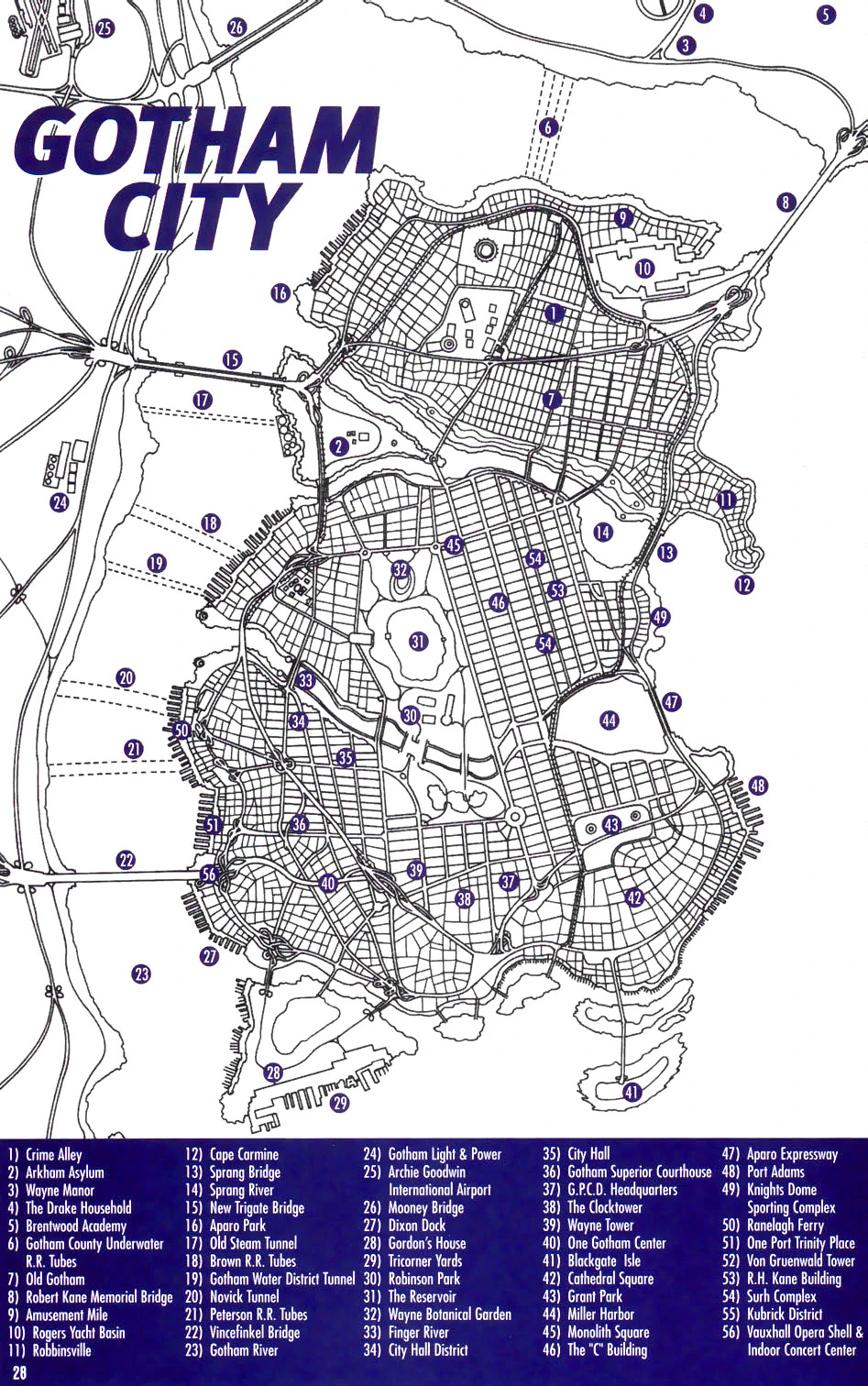

Map of Gotham.
A Gotham City driver's licence shown in Batman: Shadow of the Bat annual #1, contains the line "Gotham City, NJ", placing Gotham City in New Jersey.
Detective Comics #503 (June 1983) includes several references suggesting Gotham City is in or near New Jersey. A location on the Jersey Shore is described as "twenty miles north of Gotham." Robin and Batgirl drive from a "secret New Jersey airfield" to Gotham City and then drive on the "Hudson County Highway." Hudson County is the name of an actual New Jersey county.
Notable Residents
Many comic book series and characters are set in Gotham. The most notable characters are Batman and Robin. Some of the most prominent characters directly connected to Batman whose adventures are set in Gotham are Nightwing, Huntress, Barbara Gordon and most recently Batwoman.
Other DC characters have also depicted to be living in Gotham, including Jason Blood, Ragman, The Question, Plastic Man, Zatara and Zatanna, and Tommy Monaghan, the anti-hero Hitman. The superhero teams Section 8 and the Justice Society of America are also shown operating in Gotham City.
Within the DC Universe continuity, Batman is not the first hero in Gotham. Stories featuring Alan Scott, the Golden Age Green Lantern, set before and during World War II depict Scott living in Gotham, and later depictions[5] show him running his Gotham Broadcasting Corporation. Additionally, the Justice Society of America and the Golden Age Black Canary have been depicted as operating in Gotham. Black Canary's daughter, the Modern Age Black Canary, is based in Gotham through much of the Birds of Prey series. Arella (formerly Angela Roth), a supporting character in Teen Titans and mother of Titan member Raven, is shown in flashback to have resided in Gotham City as a teenager.
Apart from Gotham's superhero residents, the residents of the city feature in a back-up series in Detective Comics called "Tales of Gotham City" and in two limited series called Gotham Nights. Additionally, the Gotham City Police Department is the focus of the series Gotham Central.
Mayors in the Comic Books
Several mayors of Gotham have appeared in the comic book series that collectively form the "Batman Family" of titles:
- The first Mayor of Gotham seen in the comics was unnamed, but drawn to look like New York Mayor Fiorello H. LaGuardia (Batman #12 and Detective Comics #68).
- Mayor Hayes was introduced in Batman #207 (Dec. 1968).
- Hamilton Hill — A corrupt politician elected mayor thanks to the machinations of Rupert Thorne. He became mayor in Detective Comics #511 (February 1982). During his early time in office he assisted Thorne's attempts to identify and defeat Batman, principally by firing Police Commissioner (and Batman ally) James Gordon and replacing him with one of Thorne's cronies, Pater Pauling. After Thorne was defeated Hill re-instated Gordon but spent the rest of his time in office trying to shift the blame for the state of Gotham onto Gordon's shoulders. Hill last appeared in Batman #381 (March 1985), in the Pre-Crisis DC universe.
- Mayor Lieberman, plays a significant role in in Batman vs. Predator #1 (1991) and also appears in Batman: Run, Riddler, Run #1-3 and Justice Society of America vol. 2, #1.
- Armand Krol — Krol first appeared in Detective Comics #647 (August 1992). Like his predecessor he did not like Commissioner Gordon. Krol also disliked Batman until the "Knightfall" series, during which Batman saved his life. After this he turned increasingly to Batman, rather than Gotham's Police, to tackle crime in the city. He demoted James Gordon and replaced him as Commissioner with Gordon's wife, Sarah Essen Gordon. After years of self-serving incompetence, Krol lost election against Marion Grange. (Shadow of the Bat #46, January 1996). During the "lame_duck" period of his Mayoralty, Gotham finally descended into complete anarchy after Ra's al Ghul unleashed the "Clench" virus, during the "Contagion" series. Krol himself died of the virus during its second release, in the "Legacy" series. (Detective Comics #699, July 1996)
- Marion Grange — Formerly a District Attorney, Grange was elected after winning Batman's endorsement. Grange was sworn-in early by the state Governor, in the midst of the crisis caused by the Clench virus and Krol's inept handling of matters. Her first act as mayor was to forcibly eject Krol from the mayor's office, and her second was to re-appoint James Gordon as Police Commissioner. (Robin #28, April 1996) She remained mayor until Gotham was devastated by an earthquake in the "No Man's Land" series, during which she failed to prevent the federal government from cutting off Gotham. Agents of Nick Scratch assassinated her shortly afterwards.
- Daniel Danforth Dickerson III — His term ran from the end of "No Man’s Land" through the early 2000s. A corrupt mayor, his term ended with his assassination at the hands of the Joker.
- David Hull — His term ran through the mid-2000s.
While Thomas Wayne (the father of Bruce Wayne) was still living the mayor of Gotham City is named Aubrey James — he is mentioned in Batman: Legends of the Dark Knight #204 (June 2006).
A year after the Infinite Crisis, a telephone conversation between Commissioner Gordon and the current mayor indicates a change in the mayoral office. Beyond a reference to the mayor as "she", the identity of the new mayor is unknown.
Officers of the Law in the Comic Books
- Commissioner Gillian B. Loeb — The corrupt commissioner of police during the first year of Batman’s operation in Gotham.
- Commissioner Jack Grogan - he was Commissioner after Loeb and before Gordon. He was mentioned in the last page of Miller's Batman: Year One and has a one panel appearance in the Catwoman Year One Annual and also in Batman: The Man Who Laughs and Batman and the Monster Men #1.
- Commissioner James Gordon — Replaced Grogan and worked with Batman in trying to clean up the Gotham police department. When he retired, he handed the GCPD over to Michael Akins, only to take the job back some years later. The adoptive father of Barbara Gordon, the original Batgirl (Post-Crisis), and later Oracle.
- Commissioner Peter Pauling — Another corrupt commissioner, appointed by Mayor Hamilton Hill. Like Hill, he was working for Rupert Thorne. Pauling issued a shoot-to-kill order for any police officer who spotted Batman, and secretly tried to have Gordon, who was working as a private detective, killed. Pauling eventually died at Thorne's hands and a desperate Mayor Hill re-instated Commissioner Gordon. Pauling does not appear to have existed in the Post-Crisis DC universe.
- Commissioner Sarah Essen Gordon — The wife of James Gordon, appointed Commissioner by Mayor Krol while her husband was demoted. This put a great strain on her relationship with her husband and they split up for a while. Although she had previously been a critic of the Batman, she agreed to Mayor Krol's instructions that she use him. Mayor Krol sacked her after he lost his re-election bid against Marion Grange, replacing her with Andy Howe.
- Commissioner Andy Howe — A lawyer who served briefly as Commissioner during the lame-duck Mayoralty of Armand Krol. (Detective Comics #693, January 1996) When the "Clench" virus was released in Gotham and the city descended into anarchy, most police officers ignored Howe and took orders from James Gordon, at that point a private citizen. Howe lost his job when Marion Grange became Mayor and immediately re-instated James Gordon. (Robin #28, April 1996)
- Commissioner Michael Akins — Took over from James Gordon. He left the position under unspecified circumstance.
- Chief Clancy O'Hara — The longtime chief of the GCPD and aid to James Gordon, one of the few uncorruptible. He is distinguished by his big Levitz-era bushy mustache. O'Hara was the first victim of The Hangman, found hanging from the Westward bridge with a rope around his neck with a note and newspaper clipping.
- Captain Maggie Sawyer — Relocated from Metropolis to head the GCPD Major Crime Unit
- Detective Harvey Bullock
- Detective Andy Grubs — First introduced in Hawkman vol. 5, #28, he stated that he moved to St. Roch, Louisiana to get away from the likes of Batman and his foes.
- Crime Scene Investigator Jim Corrigan
- Officer Josie MacDonald - Introduced in her own backup strip in Detective Comics #763 (Dec 2001), Josie Mac has divination powers, which give her a knack for finding things (but not people). In her first appearance she is, ironically, in Missing Persons. She goes on to join the Major Crimes Unit.
- Officer Harper - The grand-niece of Jim Harper, who comes from a long line of police officers.
- Renee Montoya - Lieutenant of GCPD.
- Detective Arnold Flass - James Gordon's partner during Commissioner Loeb's tenure in "Batman: Year One" and in the film Batman Begins. Killed by the Hangman during Batman: Dark Victory.
Notable Areas, Landmarks, Institutions and Businesses
In addition to Arkham Asylum, other major facets of Gotham City seen in Batman and related comics include:
- Ace Chemical Processing Plant — The factory where a costumed criminal named the Red Hood fell into a vat of chemicals and became the Joker, in Alan Moore's Batman: The Killing Joke.
- Amusement Mile — An amusement park in Gotham, lined with ferriswheels, rollercoasters, and other attractions typical of a theme park.
- Blackgate Penitentiary — The city’s main prison, located on Blackgate Isle. Batman: The Long Halloween suggests that it was preceded by Gotham Penitentiary.
- The Bowery — Described in the comics as Gotham City's worst neighborhood. Bordered by Crime Alley to the north, The Bowery is home to Crown Point, a smaller inner-district ridden with crime, homelessness, and prostitution.
- Brentwood Academy — A privately run high school once attended by Tim Drake during Chuck Dixon's tenure as writer of Robin vol. 2.
- Burnley — A district located north of Sprang River that is connected with Mercey Island via the Schwartz Bypass. Named for writer Jack Burnley.
- The Cauldron — An area known for organized crime. The Irish Mob runs most of The Cauldron and it is home to some of the most prestigious hitmen in the city, per Hitman by Garth Ennis and John McCrea.
- The Clocktower — A tower in central Gotham which at one time contained the secret headquarters of Barbara Gordon, for her activities as Oracle. The "War Games" storyline shows the destruction of the Clocktower.
- Chinatown — Gotham's primary Asian district.
- Coventry
- Crime Alley — A small side street, located in the East End, formally "Park Row." It is a dangerous, crime-infested area. This is where Joe Chill killed Thomas and Martha Wayne in front of their young son, Bruce, after the family had visited a cinema. In addition, this is the location where Batman first met Jason Todd, when the youth attempted to steal the tires from the Batmobile. This is also where Doctor Leslie Thompkins maintains her clinic, and where Batman battles Superman in Batman: The Dark Knight Returns.
- Diamond District — An area run by the Penguin during the No Man's Land series.
- East End — An underdeveloped part of Gotham laden with poverty, crime, prostitution, and the circulation of illegal drugs. Some writers occasionally blend the East End together with Crime Alley as a single area in the city. In the Catwoman series, especially volume 3, Catwoman takes an active interest in protecting this area.
- Falcone Penthouse — This was the home of Carmine Falcone before Two-Face killed him. This was also the place where Batman first encountered Catwoman, and first faced Two-Face, all of this in Batman: The Long Halloween.
- Fashion District — An area run by the Penguin during the No Man's Land series.
- Financial District
- Finnigan's — A bar popular with uniformed police officers in Gotham.
- Gotham County High School — A public high school once attended by Tim Drake.
- Gotham Docks — This is the city's harbor. Among other stories, the harbor figures in Batman: The Long Halloween as the place the coroner's body is found.
- Gotham Heights — An affluent area also known as "Bristol" and/or "Crest Hill", due to mutual proximity of the three neighborhoods. This is where Wayne Manor is located.
- Gotham Square — A central area of the city resembling New York City's Times Square.
- Gotham Village — In 1970s comics this was a bohemian area, based on New York City's Greenwich Village.
- Grand Avenue — The city's main theatre district based on New York City's Broadway.
- The Hill
- The Iceberg Lounge — A nightclub in the city center operated by the Penguin.
- Killinger's Department Store — A large department store similar to Macy's in New York.
- Mercey Island — An island in the northern part of Gotham City that is home to Arkham Asylum and the D'Angelo Sewage Treatment Plant.
- Monarch Playing Card Co. — The playing card factory adjacent to Ace Chemical Processing that the Red Hood was attempting to rob before encountering the Batman and fleeing.
- My Alibi — An underworld bar in the city center.
- The Narrows — A run-down part of Gotham City that is located on a small island surrounded by the Finger River. The Gotham Narrows were originally created for the Nolanverse, but later incorporated into the regular comic continuity during the New 52 era.
- New Town- An area in which during the No Man's Land series, was the district operated by the Ventriloquist and his puppet Scarface.
- Old Gotham — The Gotham district more well known for the location of Oracle's Clock Tower and the GCPD headquarters.
- Otisburg
- Park Row— The place where the Solomon Wayne Courthouse is located.
- Plant Factory — The place where Batman first fought Poison Ivy during his first year of operation. It apparently burned to the ground by the end of the battle.
- Robinson Park — The city’s main park. During "No Man's Land," Poison Ivy claimed this area as her own. Named for 1940s Batman artist and Joker co-creator Jerry Robinson.
- The Stacked Deck — A seedy nightclub where the most notorious criminals in Gotham go to hide out sometimes.
- The Statue of Justice — Also known as "Lady Gotham," this is a monument situated off shore of the city and modeled loosely on the Statue of Liberty in New York. It varies in that the figure has a blindfold over her eyes, and a sword and scales in her outstretched hands.
- Slaughter Swamp — Just outside Gotham, this swamp 'birthed' Solomon Grundy, a frequent villain to Alan Scott.
- Sullivan Island — A small island off the coast of Old Gotham that is connected with Downtown Gotham City via two bridges. It is sometimes also known as Elsa Island.
- Tricorner — An island at the southwest corner of Gotham City. It is home to the Tricorner Yards.
- Toxic Acres — An abandoned neighborhood of newly built houses, unsuitable for habitation due to its proximity to a toxic waste dump. To prevent illness, those entering or staying in the area need to use gas masks or take antivenin. At one-time Poison Ivy and Harley Quinn used the area as a hideout.
- Wayne Manor — Also referred to as "Wayne Mansion" or "Stately Wayne Manor," this is the mansion estate of Bruce Wayne, and the location of the Batcave.
- Wayne Tower — This is the headquarters of Wayne Enterprises, located at the corner of Finger and Broome Streets. Named for comic creators Bill Finger and John Broome.
Many other areas and landmarks have been referred to more inconsistently in the comics and most are named in homage to important Batman creators. These include:
- Aparo Expressway — Named for artist Jim Aparo.
- Aparo Park — Also named for artist Jim Aparo.
- Archie Goodwin International Airport — Named for writer and editor Archie Goodwin.
- Barr Town — Named for writer Mike W. Barr.
- Cape Carmine — Named for artist Carmine Infantino.
- Davis Avenue — Named for artist Alan Davis.
- Dixon Dock — Named for writer Chuck Dixon.
- Finger River — Named for Batman co-creator Bill Finger.
- Finger Memorial Park — Also named for Batman co-creator Bill Finger.
- Grant Park — Named for writer Alan Grant.
- Kane County Morgue — named for Batman's creator Bob Kane, services Gotham City.
- Miller Harbor — Named for writer and artist Frank Miller.
- Novick Tunnel — Named for artist Irv Novick.
- Puckett Park ---- Named for writer Kelley Puckett. During No Man's Land, Batman buried 6 residents of his territory here after they were murdered by Two-Face.
- Robbinsville — Named for artist Frank Robbins.
- Robinson Plaza — Named for artist Jerry Robinson.
- Robinson Square — Also named for artist Jerry Robinson.
- R.H. Kane Building — Named for Batman co-creator Bob Kane.
- Robert Kane Memorial Bridge — Also named for Batman co-creator Bob Kane.
- Schwartz Bypass — Named for writer Alvin Schwartz.
- Sprang Bridge — Named for artist Dick Sprang.
- Sprang River — Also named for artist Dick Sprang.
- The Westward Bridge — Named for actors Adam West and Burt Ward.
Gotham City is a major economic center within the United States of the DC Multiverse; its important industries include: manufacturing; shipping; finance; fine arts, represented by its numerous museums, galleries, and jewelers; and the production of giant novelty props. In addition to its commercial seaport, it also supports a naval shipyard.
Major businesses based in Gotham City include its most noteworthy corporation: Wayne Enterprises, which specializes in various industrial aspects and advanced technological research and development.
Noteworthy newspapers in Gotham City include the Gotham Gazette. In the Silver Age comics, the editor-in-chief of Metropolis newspaper The Daily Planet, Perry White, had once worked for the Gazette early in his career.
In Other Media
Television
1960s Batman Series
The 1960s live-action Batman television series never specified Gotham's location. The related spinoff movie, however, showed Gotham to have a harbor and a beach. One episode refers to Gotham Rock, implying a location analogous to Boston.[6]
DC Animated Universe
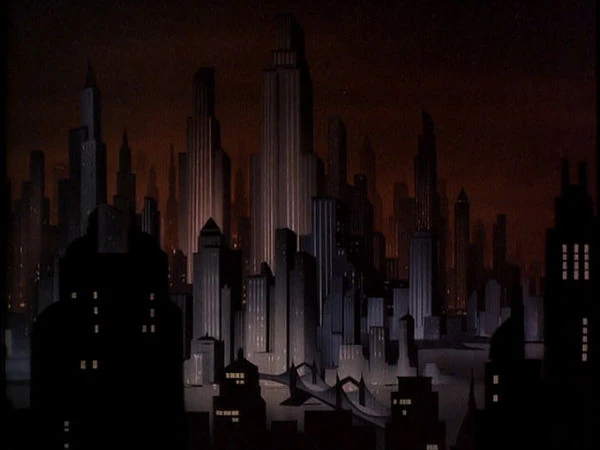

Gotham City in Batman: The Animated Series
In a first season episode entitled "Joker's Favor," Batman: The Animated Series depicted a driver's license of a Gotham area resident, listing his hometown as "Gotham Estates, NY". This implies that Gotham City borders or is within the state of New York, and has suburbs (such as Gotham Estates) within commuting distance. In one episode, when Bruce Wayne leaves for England, it shows Gotham City located on New York's Long Island, clearly in the same location of Queens County.
Another episode of the same television show, however, implies that Gotham resides in a state of the same name. A prison workshop was shown stamping license plates that read "Gotham - The Dark Deco State" (as a reference to the artistic style of the series, this plate may have been intended to simply be one of the visual gags that were common on the program). In addition, the episode entitled "Harlequinade" states that Gotham City has a population of approximately 10 million people.
During the events of the direct to video Batman & Mr. Freeze: SubZero, a computer screen displaying Barbara Gordon's personal information shows Gotham City, NY, but also displays her area code as being 212, a common Manhattan area code
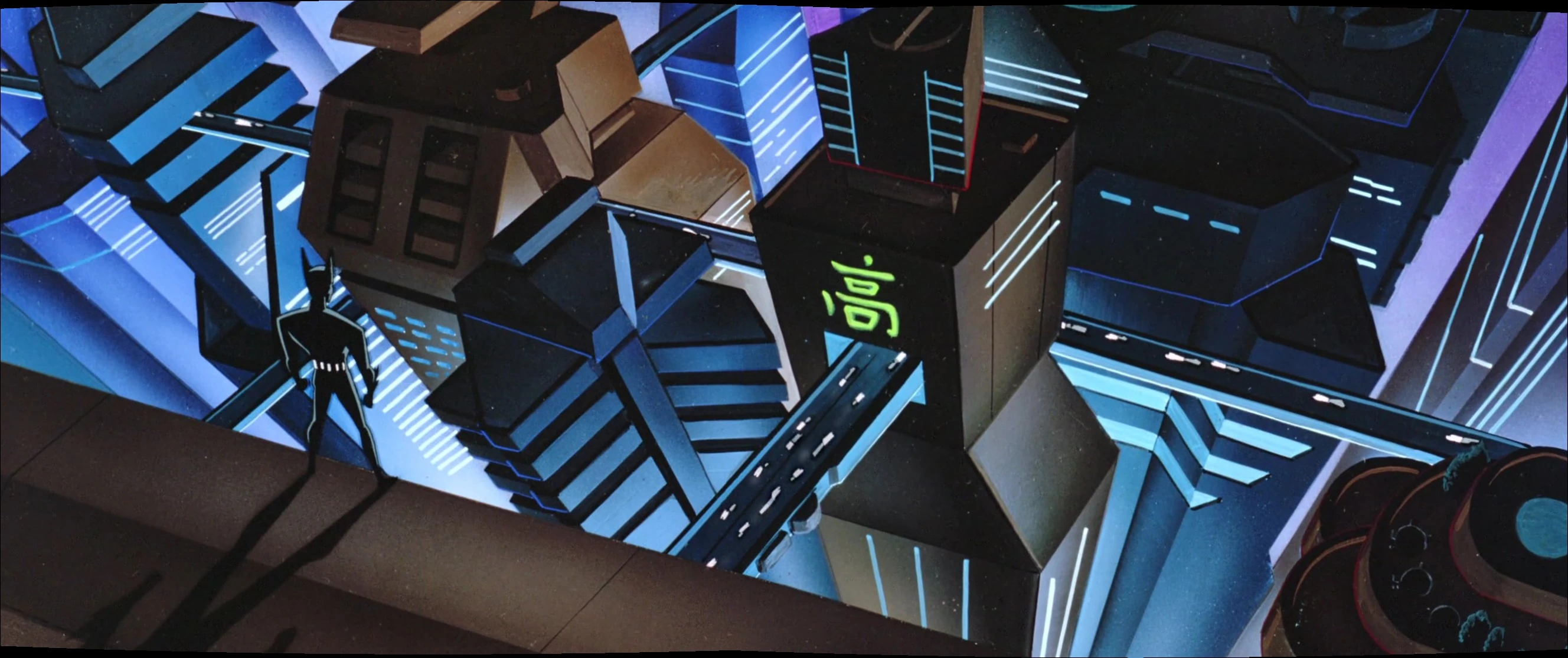

Batman looking over Neo Gotham in Batman Beyond
Batman Beyond envisions a Gotham City fifty years into the future known as Neo Gotham City. In it, a futuristic architecture which mixes gothic and Asian influences, reminiscent of the films Akira and Blade Runner, with elevated streets looping around buildings, has replaced the gothic architecture based on early 20th century American city.
The Batman
Batman: The Brave and the Bold
Beware the Batman
Gotham
The show envisions Gotham City prior to Bruce Wayne becoming Batman. In the first season Gotham is under control of mob boss Carmine Falcone who has the police department and courts in his pocket. Newly appointed detective James Gordon works to try and deal with the corruption in the city. Following the murder of Thomas and Martha Wayne, the city sees as escalation of bizarre crimes and Falcone desperately tries to keep order in the city. A mob war escalates between Falcone and Sal Maroni due to the manipulations of The Penguin, which concludes with Maroni's death, Falcone retiring to Miami and Penguin becoming the new ruling crime lord of the city.
In the aftermath of the downfall of the Falcone crime family in the city, Gotham begins to see the rise of supervillains such as Firefly, Mr Freeze, Jerome Valeska, Azrael, etc. Hugo Strange uses his position at Arkham Asylum to create monsters in the basement on the orders of the Court of Owls, the latter whom are revealed to have been secretly controlling Gotham behind the scenes for centuries. The monsters end up escaping a prison bus during transport and create chaos in the city. The Penguin (who accidentally led to the monsters escaping) waged a war against Hugo Strange's experiments and had most of them killed off. This won him public approval and Penguin won the election as the new mayor of the city. But his tenure became short lived when his former friend Edward Nygma overthrew Penguin as revenge for Penguin killing Nygma's girlfriend Isabella.
During all of this Gotham once again fell victim to further chaos. Jervis Tetch began to spread chaos in the city as revenge against Jim Gordon for the death of Tetch's sister Alice. Captain Nathaniel Barnes became infected with Alice's tainted blood which caused him to turn into a supervillain known as "The Executioner" and begin wiping out criminals before being locked up at Arkham Asylum alongside Tetch. Jerome Valeska is then resurrected from the dead by his loyalists and proceeds to cause a blackout in the city to bring out people's true nature. Jerome is subdued by Bruce Wayne and sent to Arkham Asylum.
The ensuing chaos and insanity causes the Court of Owls to plan to destroy the city in order to rebuild. They get their hands on Alice Tetch's blood and weaponise it into a biological weapon. Despite Gordon's attempts to prevent the attack, the Court successfully release the virus into the city, causing the population to go insane and begin attacking each other. Fortunately Jervis Tetch's blood held the answer to curing the virus, so his blood got obtained and turned into a cure. The Court of Owls were also wiped out on the orders of their true master Ra's al Ghul, who wished to assist Bruce Wayne's path to becoming the city's protector. As such Bruce begins working as a vigilante in the city.
The Penguin again gains complete control over the Gotham underworld and makes sure criminals get a license before committing an illegal act. This creates a good relationship between Penguin and the police department, although Gordon wants Penguin brought down. Gordon attempts to bring Falcone out of retirement, although he refuses due to not having long left.
Harley Quinn

|
This section is a stub. You can help the Batman wiki by expanding it. |
Film
Burton Films
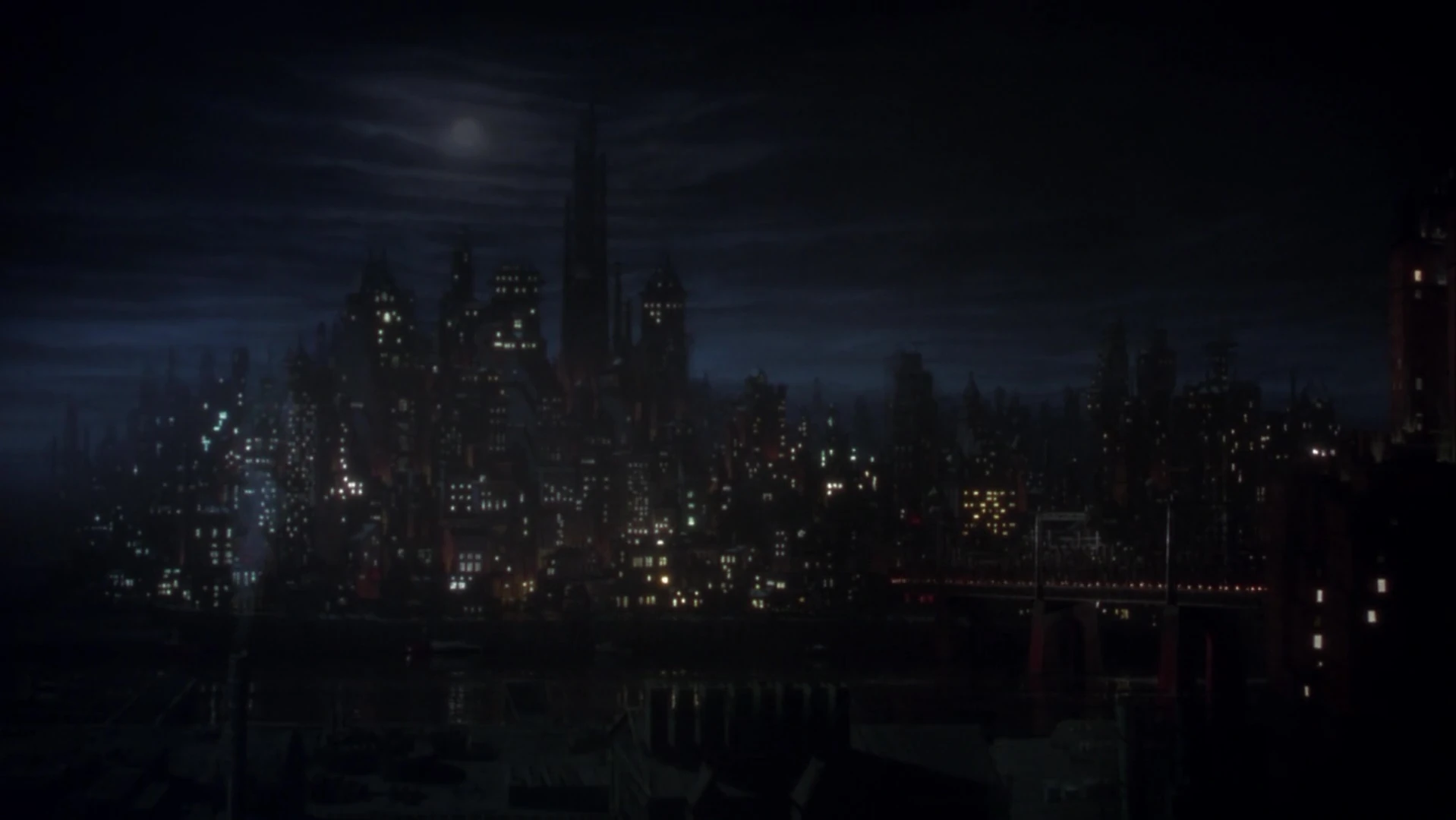

Gotham City skyline as seen in Batman.
A map of Gotham City used in the film Batman (1989) was actually an inverted map of Vancouver, British Columbia, Canada. In the same movie, a map of the Axis Chemical plant was actually a map of the Capitol Hill neighborhood in Burnaby, British Columbia, Canada.
Nigel Phelps created charcoal city drawings for the first Batman film directed by Tim Burton. The set designs for the Batman movie were an attempt to imagine what might have happened to New York City had there been no planning commission and had it been run by pure extortion and crime. Hence, there were no height restrictions, the skyscrapers were cantilevered toward the street rather than away, there were lots of bridges over the streets. In return, the city appeared to be extremely dark and claustrophobic.
The individual buildings in this version of Gotham were mostly based on the work of Shin Takamatsus, specifically the Monarch Theatre and Flugelheim Museum exteriors were lifted directly from his work. The Old Gotham Cathedral was based on Antoni Gaudí's Sagrada Família. Some of the other influences were Otto Wagner, Norman Foster, and Albert Speer. The concept was to to having contrasting art styles from different eras all over the world so that final look would hopefully rest nowhere in any specific time.
For Wayne Manor, Knebworth House, a Gothic Tudor mansion 28 miles north of London was used for the exterior. The interior however, is Hatfield House, Hertfordshire.
For Tim Burton's second Batman film, Batman Returns (1992), Bo Welch oversaw over the production design duties, artwork was done by Tom Lay and Tim Flattery. The second film leans more on World's Fair, fascist Russian statues and late 50's/early 60's industrial design for Gotham Plaza. Some critics drew comparisons to Fritz Lang's Metropolis.[7][8][9] The Arctic World pavilion at the Old Zoo with extreme distorted, Expressionistic angles was very different from anything seen the first film. This area was inspired in Central Park in New York.
Schumacher Films
When Joel Schumacher took over directing the Batman films from Tim Burton, Barbara Ling handled the production design for both of Schumacher's films (1995's Batman Forever[10] and 1997's Batman & Robin[11]). Ling's vision of Gotham City was a luminous and marvelously outlandish evocation of Modern expressionism.[12] Its futuristic-like concepts (to a certain extent, akin to the 1982 film Blade Runner[13]) appeared to be sort of a cross between Manhattan and Neo-Tokyo.
Batman Forever was going to be shot in Cincinnati, using the old subway tunnel. The exterior of the Gotham City Hippodrome (the arena where the "Flying Graysons" performed their trapeze act) is based on the exterior of Union Terminal, a famous 1930s Art Deco train station in Cincinnati.[14]
Exterior scenes of Wayne Manor for Batman Forever were filmed at the Webb Institute of Naval Architecture in Long Island, New York. The production team had to change the school's "W" on the entrance gate because it had an anchor behind it. When left at Wayne Manor in Batman Forever, Dick Grayson informs Bruce Wayne that he is leaving. To this, Bruce replies that the circus would be halfway to Metropolis, which is the city of Superman.
The exterior set for Two-Face's hideout in Batman Forever was the same set used in the first disappearance of Max Shreck in Batman Returns.
The Arkham Asylum that was seen in Batman Forever was designed as a tall, spiraling castle-like structure, with narrow hallways lined with brightly-lit glass bricks.
During Mr. Freeze’s attempt to freeze Gotham in the film Batman and Robin, the targeting screen for his giant laser locates it somewhere on the New England shoreline, possibly as far north as Maine.
Dark Knight Trilogy
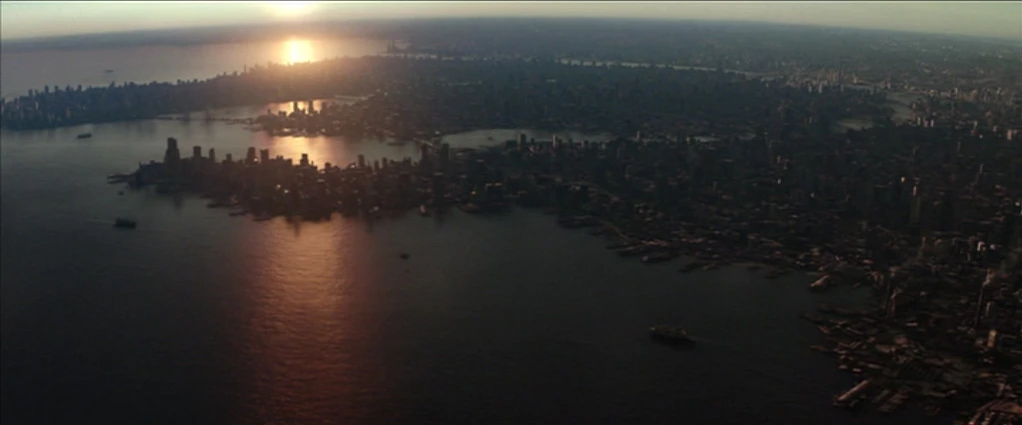

Gotham City as depicted in Batman Begins
Batman Begins (2005) leaves the location of Gotham ambiguous. Alfred comments that the caverns beneath Wayne Manor that are to be converted into the Batcave were once used by a Wayne ancestor to hide escaping slaves in the Underground Railroad. This places the location anywhere from the northeast United States to Iowa. In another scene involving the new 'Batmobile', a reference to I-17 is made. In reality, however, Interstate 17 is located entirely within the state of Arizona. For Wayne Manor itself, the former Rothschild estate, Mentmore Towers in Buckinghamshire, was used to portray its exterior and interior.
The Gotham depicted in Batman Begins is a digitally-enhanced Chicago, complete with its famous elevated train tracks, skyline, and subterranean streets filmed on Lower Wacker Drive. Various Chicago skyscrapers are visible in several shots, including a part of the Sears Tower, Two Prudential Plaza, and the twin Marina City towers. Even the automobile license plates shown throughout the film are reminiscent of Illinois' license plate design. The Chicago Board of Trade was the visual inspiration for the film's Wayne Tower design.
Director Christopher Nolan worked with production designer Nathan Crowley to create the look of Gotham City. Nolan designed Gotham City to be a large, modern metropolitan area that would reflect the various periods of architecture that the city had gone through. Elements were drawn from New York City, Chicago, Tokyo, and Detroit, the latter for its elevated freeways and monorails.
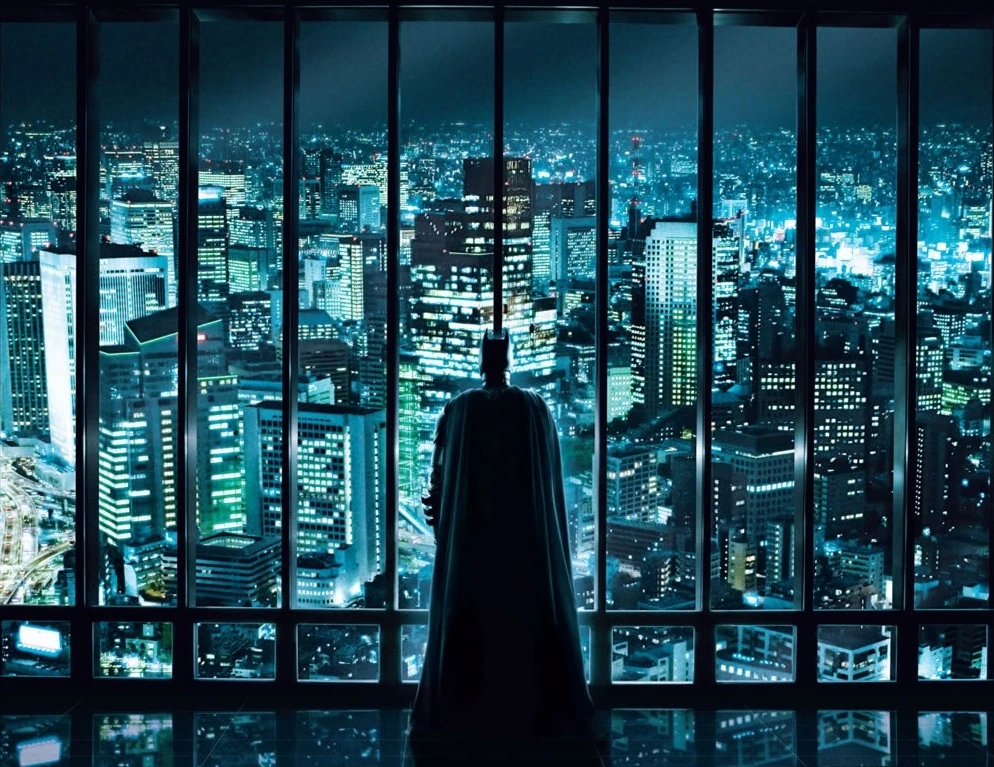

The Dark Knight is the watchful protector of Gotham City.
In Batman Begins, the Narrows was based on the slummish nature of the now-demolished walled city of Kowloon in Hong Kong. One notable change in this version of Arkham Asylum from the comics was the location. While the location has varied in the comics, it is generally located some distance outside of Gotham City, often in a rural or forested location. However, Batman Begins has it in the middle of Gotham City, located in the Narrows.
In The Dark Knight, Chicago was used for Gotham City, with most of the filming being done there.
In The Dark Knight Rises, multiple cities were used, including Pittsburg, New York, Newmark, Los Angeles, London and Glasgow.
DC Extended Universe
Joker
DC Universe
Video Games
LEGO Series
|
|
This section is a stub. You can help the Batman wiki by expanding it. |
Batman Arkham Series
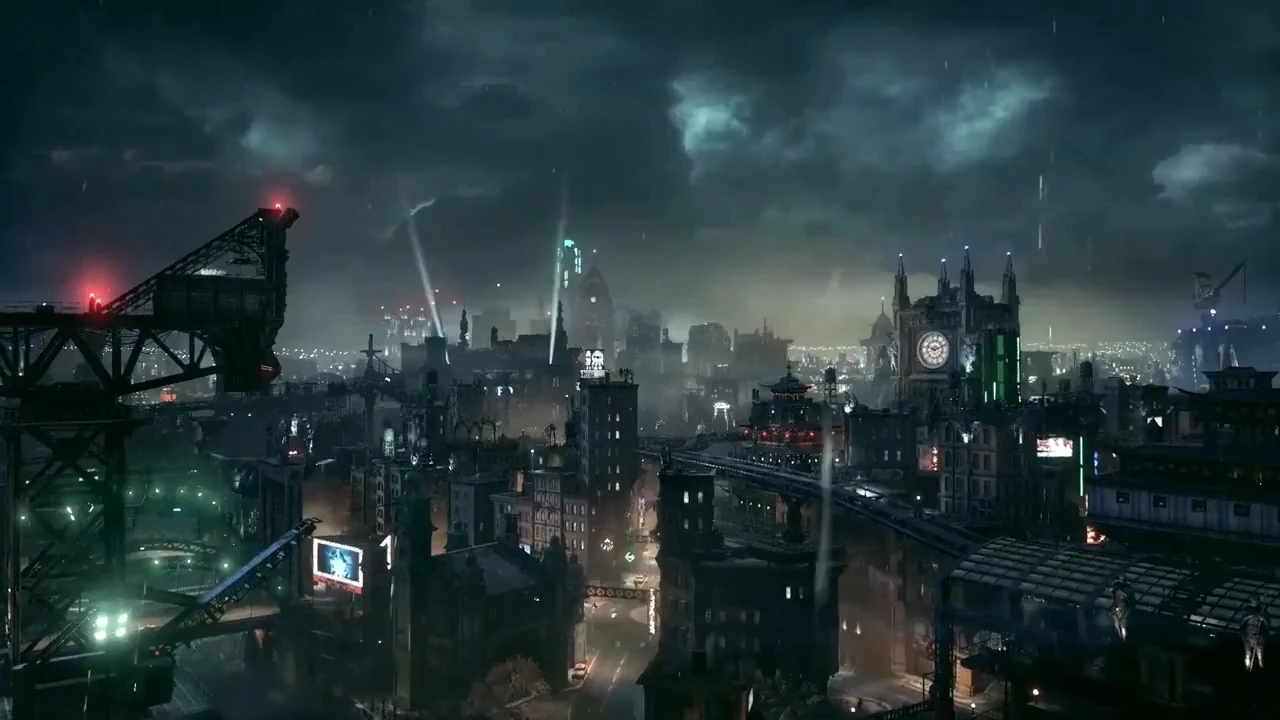

Gotham City in Batman: Arkham Knight.
Only small parts of Gotham appear in the game series. In Batman: Arkham Origins, Gotham is consisted of two areas, Old Gotham and New Gotham. In Batman: Arkham Asylum only a small island named Arkham Island is seen in depth but the City can be seen across the water. In Batman: Arkham City Old Gotham is walled off to become the new prison named Arkham City. In Arkham City, it is surrounded by Old Gotham from Arkham Origins, which shows similarities with the gothic architecture in the comics. Also, Arkham City includes Crime Alley, The Bowery, and other areas, showing its urban decay in this city-wide prison. About one year later, in Batman: Arkham Knight, without the Joker's chaotic presence, Gotham's citizens have never felt safer, and crime in the city has dramatically declined. However, Scarecrow's latest plan forces Gotham's civilians to evacuate the city. Only criminals remain in the city, leaving Commissioner Gordon and the Gotham City Police overwhelmed.
Landmarks in other media
- Batman: The Animated Series
- The Statue of Justice — The statue varies from the comics in that she is shown holding a shield and a torch.
- Stonegate Prison — The city's main prison as opposed to "Blackgate" in the comics.
- Batman Beyond
- Crime Alley — Bruce Wayne used his influence to keep the street preserved during the rebuilding of Gotham, making it the only part of the present-day Gotham City to remain as it is.
- Batman (1989 film)
- Axis Chemicals — The factory where Jack Napier fell into a vat of chemicals and became the Joker. The name differs from Ace Chemical Processing Inc. in the comics.
- Christopher Nolan's Universe
- The Narrows — An even seedier, grittier portion of Gotham than the East End, an actual slum. Dangerous and dilapidated, the residents of the city often view the area as the "skid row" of Gotham. The area is located on an island in the middle of Gotham River between Midtown and Downtown, connected to Gotham proper by nine drawbridges (as depicted in a map commissioned by Christopher Nolan based on the No Man's Land map; the novel says three drawbridges and a tunnel). Arkham Asylum is located in this area, at the East end of the Narrows. The Narrows was later evacuated of all sane inhabitants after the mass breakout from Arkham. GCPD officers erected gaurd towers, searchlights, and kept the drawbridges raised, in order to keep people from getting off or on the island without permission. The Narrows is now an "extension" of Arkham asylum. Occasionally, fires start in the dilapidated neighborhoods, apparently caused by an inmate who was an arsonist trying to drive out "demons" residing in the buildings (as explained in the Gotham Knight novel).
- Gotham (TV series)
- Mooney's - The nightclub of Fish Mooney, which was later taken over by the Penguin.
- Galavan Tower - One of the tallest skyscrapers in Gotham City. The building's penthouse was inhabited by Theo and Tabitha Galavan.
- Van Dahl Mansion - Penguin's house on the outskirts of Gotham City. It was originally owned by his father Elijah Van Dahl.
- The Sirens - A nightclub owned by Barbara Kean, Tabitha Galavan and Selina Kyle. The name is an allusion to the Gotham City Sirens.
- Cherry's - A fightclub in the Gotham Narrows, originally owned and operated by Cherry up until her death. The club was later taken over by Lee Thompkins who turned it into her headquarters when she tried to help the people of the Narrows.
Alternate officers of the law
- Batman (1989 film)
- Lieutenant Max Eckhardt, played by William Hootkins. A corrupt cop echoing some of the Pre-Crisis aspects of Harvey Bullock.
- Birds of Prey (TV series from 2002-2003)
- Detective Jesse Reese - Was played by Shemar Moore. The only honest cop in New Gotham who can help the Birds of Prey.
- The Batman (TV series started in 2004)
- Chief Angel Rojas — Edward James Olmos and Jesse Corti provide his voice for this show.
- Detective Ellen Yin — Ming-Na provides her voice in this show.
- Detective Ethan Bennett — He is a childhood friend of Bruce Wayne's. Due to a chemical created by the Joker, he becomes the Clayface for this series. Steve Harris provides his voice.
- Gotham (TV series)
- Detective Dix, played by Dan Hedaya. The mentor and former partner of Harvey Bullock who retired after an accident left him paralyzed. He was later murdered by Jane Doe during No Man's Land.
- Captain Nathaniel Barnes, played by Michael Chiklis. A former marine who becomes the new GCPD captain after the death of Sarah Essen. He is later infected with the Alice Tetch virus and becomes the Executioner, a brutal vigilante who murders criminals.
- Commissioner Reynolds, played by Harry Sutton Jr..
Mayors in other media
- Batman (1960s live-action TV series)
- Mayor Linseed, played by Byron Keith. His name was a play on the name of New York City's then-mayor, John Lindsay. The governor of "Gotham State" was Stonefeller (as opposed to Nelson Rockefeller, who was governor of New York State during the same period). There was also a West River (as opposed to New York's East River), and "Bernie Park's Gallery", compared to the real Park Bernet Gallery.
- Batman (1989 film)
- Mayor Borg, played by Lee Wallace.
- Roscoe Jenkins, played by Michael Murphy.
- An unnamed mayor played by George Wallace.
- Hamilton Hill — Lloyd Bochner provides his voice in this television show. In Batman Beyond, there is a high school named after him.
- The Batman (TV series started in 2004)
- Marion Grange — In a divergence from the comics, the Grange is a male, not a female, character. Adam West, who played Batman in the first television series, provides his voice.
- The Dark Knight Trilogy
- Anthony Garcia, played by Nestor Carbonell. Elected mayor between Batman Begins and The Dark Knight, he is later killed by Bane during The Dark Knight Rises.
- Gotham (TV series)
- Aubrey James, played by Richard Kind.
- Theodore Galavan, played by James Frain.
- Oswald Cobblepot, played by Robin Lord Taylor.
- Mayor Burke, played by Larry Pine. - He was the Mayor of Gotham in the year preceding the No Man's Land crisis. Burke was inside the Gotham City Hall when the building was destroyed by one of Jeremiah Valeska's bombs.
- Holden Pritchard, played by Peter McRobbie.
- Mayor Chang, played by Ann Harada. - The new mayor following the end of No Man's Land. She was responsible for promoting Jim Gordon to the rank of Commissioner.
- Batman: Arkham Series (Video Game)
- Quincy Sharp— Voiced by Tom Kane, former Arkham Asylum warden becomes mayor through the manipulations of Hugo Strange and the League of Assassins, acting as a puppet for the group.
- Batman: The Telltale Series(Video Game)
- Hamilton Hill — Voiced by Bob Pescovitz, Hill is portrayed similar to his comic iteration, albeit with ties to Carmine Falcone and Thomas Wayne.
- Harvey Dent — Voiced by Travis Willingham, Dent assumes the role of mayor after Hill's death.
Trivia
- The name Gotham was chosen by both Bill Finger whilst looking through a phone book for names. He decided on the name after spotting a jewelry business called 'Gotham Jewelers'.
- Original names prior to Gotham included Civic City, Capital City, and Coast City. Some of these names were later used for other cities in the DC Universe, with Civic used as the main place of operations for the Justice Society and Coast City being used for the second Green Lantern (Hal Jordan).
- In old English, Gotham translates to "Goat's Town".
- A village in Nottinghamshire also shares the name Gotham. The town is located roughly three miles south from Wollaton Hall, which was used as the filming location for Wayne Manor in The Dark Knight Rises.
References
- ↑ Swamp Thing #52 (September, 1986)
- ↑ Daily Planet Guide to Gotham City (2000)
- ↑ 3.0 3.1 Atlas of the DC Universe
- ↑ O'Neil, Dennis. Afterword. Batman: Knightfall, A Novel. New York: Bantam Books, 1994. 344.
- ↑ Detective Comics #784-786
- ↑ http://members.tripod.com/AdamWest/tour.htm
- ↑ And the sinister visual grandeur of the late Anton Furst has given way to the more whimsical approach
- ↑ The sets by Bo Welch are amazing, a Teutonic, "Metropolis"-like Gotham -- perfect to house the larger than life characters.
- ↑ The three-way story, involving Keaton's Batman, DeVito's Penguin and Pfeiffer's Catwoman, takes place in a wonderland of moody sets by Bo Welch.
- ↑ In collaboration with production designer Barbara Ling and her crew, Schumacher has kept the series' dark and monumental look (the legacy of Frank Miller's brilliant graphic novel "Batman: The Dark Knight Returns") and, as advertised, lightened the project's overall tone.
- ↑ Barbara Ling's no-holds-barred production design makes Gotham look more surreal than ever.
- ↑ Batman & Robin's look is luminous and marvelously outlandish throughout. Barbara Ling's production design is outstanding, a stunning evocation of modern Expressionism.
- ↑ Departing from former "Batman" director Tim Burton's gothic approach to New York, Schumacher and production designer Barbara Ling compulsively layer the background with a futuristic city design that seems to aim for "Blade Runner" by way of "Teenage Mutant Ninja Turtles."
- ↑ http://www.imdb.com/title/tt0112462/trivia
Sources
- Brady, Matthew and Williams, Dwight. Daily Planet Guide to Gotham City. Honesdale, Pennsylvania: West End Games under license from DC Comics, 2000.
- Brown, Eliot. "Gotham City Skyline". Secret Files & Origins Guide to the DC Universe 2000. New York: DC Comics, 2000.
- Grant, Alan. "The Last Arkham". Batman: Shadow of the Bat #1. New York: DC Comics, 1992.
- Loeb, Jeph. Batman: The Long Halloween. New York: DC Comics, 1997.
- Miller, Frank. Batman: Year One. New York: DC Comics, 1988.
- Morrison, Grant. Arkham Asylum. New York: DC Comics, 1990.
- O'Neil, Dennis. "Destroyer". Batman: Legends of the Dark Knight #27. New York: DC Comics, 1992.